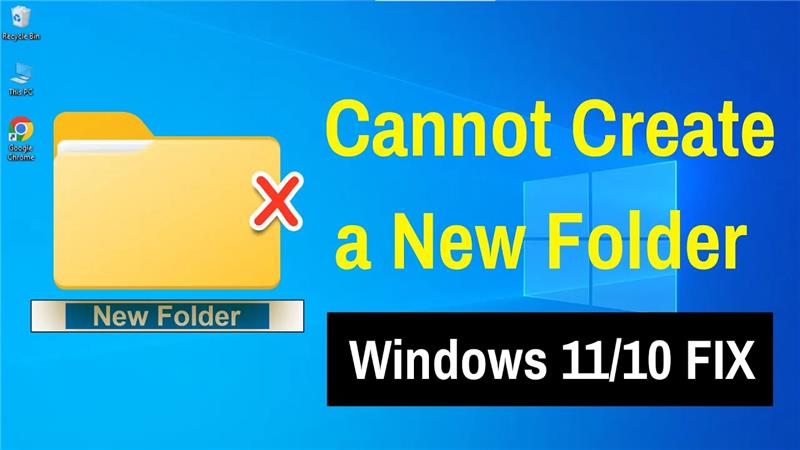
Sometimes on Windows 10 or Windows 11, you may try to create a new folder but nothing happens—the option doesn’t work or the folder won’t appear. This can be really annoying, especially when you need to organize files quickly. The good news is, this is a common issue and can usually be fixed with a few simple steps. In this blog, we’ll explain in easy language how to fix the problem of not being able to create a new folder in Windows 10/11, so you can get back to managing your files smoothly.
Step-by-Step Fixes for the “Cannot Create New Folder” Issue
1. Restart File Explorer
Sometimes File Explorer (Windows Explorer) just glitched out.
- Press Ctrl + Shift + Esc to open Task Manager.
- In the Processes tab, find Windows Explorer, right-click → Restart.
- After restarting Explorer, try creating a new folder again.
2. Use Keyboard Shortcut to Create a Folder
Even if right-click doesn’t work, the shortcut might:
- Press Ctrl + Shift + N in File Explorer (or on desktop).
- If this works, the issue might be with the context menu rather than permissions.
3. Check and Fix Folder / Drive Permissions
- Right-click inside the parent folder (or drive) → Properties → Security tab.
- Select your user account → click Edit → make sure Write and Modify permissions are enabled.
- If permissions were wrong, apply the changes and try again.
4. Run System File Checker (SFC) to Repair Corrupted Files
Corrupted system files can block folder creation:
- Open Command Prompt as Administrator.
- Run the command:
sfc /scannow - Wait for the scan to complete — it will automatically repair corrupted files if any.
- Once done, restart your PC and check if you can create a folder.
5. Edit the Registry to Restore the “New → Folder” Menu Option
If the New → Folder option is missing, you may need to fix a registry key:
- Press Win + R, type
regedit, and hit Enter to open Registry Editor. - Navigate to:
HKEY_CLASSES_ROOT\Directory\Background\shellex\ContextMenuHandlers - If there’s no New key under
ContextMenuHandlers, right-click → New → Key, name itNew - Select the
Newkey → double-click(Default)value → set its data to:{D969A300-E7FF-11d0-A93B-00A0C90F2719} - Close the Registry Editor and restart File Explorer (see step 1).
- Now try right-clicking → New → Folder again.
6. Reset File Explorer to Default Settings
Custom settings in File Explorer might interfere:
- Open File Explorer → click on the three-dot menu (… ) → Options.
- In Folder Options window → click Restore Defaults → Apply, then OK.
- Restart File Explorer and test folder creation.
7. Disable Third-Party Antivirus or Shell Extensions
Antivirus or context-menu utilities can block actions:
- Temporarily disable your antivirus and check if folder creation starts working.
- Use a tool like ShellExView to disable non-Microsoft shell extensions one by one. Some third-party “right-click” utilities or optimizers might be messing up the context menu.
- After disabling, restart Explorer and test again.
8. Perform a Clean Boot
To check whether startup apps are causing the issue:
- Press Win + R, type
msconfig, and hit Enter. - In the System Configuration → Services tab → check Hide all Microsoft services → click Disable all.
- Go to the Startup tab → open Task Manager → disable all non-essential startup apps.
- Restart your PC → try creating a folder again. If it works, some third-party software is interfering.
9. Run Microsoft’s File and Folder Troubleshooter
Microsoft used to have a dedicated troubleshooter:
- Download the File and Folder Troubleshooter from Microsoft / trusted sites.
- Run it and follow on-screen instructions — it can automatically detect and fix issues related to file creation.
10. Use System Restore (If Nothing Else Works)
If the issue started recently:
- Use System Restore to revert your Windows installation to a point before the problem began.
- This may fix registry changes, permission issues, or updates that broke the “New Folder” functionality.
Conclusion
The inability to create new folders in Windows 10 or 11 usually stems from permissions issues, missing registry keys, or third-party software interference. By following the steps above — from restarting File Explorer to fixing registry entries — most users can restore the “New Folder” functionality. Start with the simpler fixes, and only move toward registry edits or clean boots if needed.